





Osteoarthritis
Osteoarthritis is a common degenerative disease that affects the hyaline cartilage covering the joints, causing its wear and destruction, which leads to pain and difficulty in movement.
Osteoarthritis, also called degenerative joint disease, is caused by alterations in the cartilage and is characterized by pain, stiffness, and loss of function in the affected joint.
It is a common disorder that usually begins to appear after the age of 40 and affects nearly all people aged 80 or older.
It can occur in the hips, knees, hands, feet, and the cervical and lumbar spine. Although it is more common in the hips and knees, it can also affect certain joints of the shoulder and fingers, particularly the joint at the base of the thumb and the joint at the base of the big toe.
Cartilage is a tissue that acts as a cushion between two or more bone surfaces. It is firm yet flexible and covers the ends of bones within a joint. It also provides shape and support to other parts of the body, such as the ears, nose, and trachea. Healthy cartilage reduces friction within the joint, facilitates movement, and protects the ends of the bones from wear.
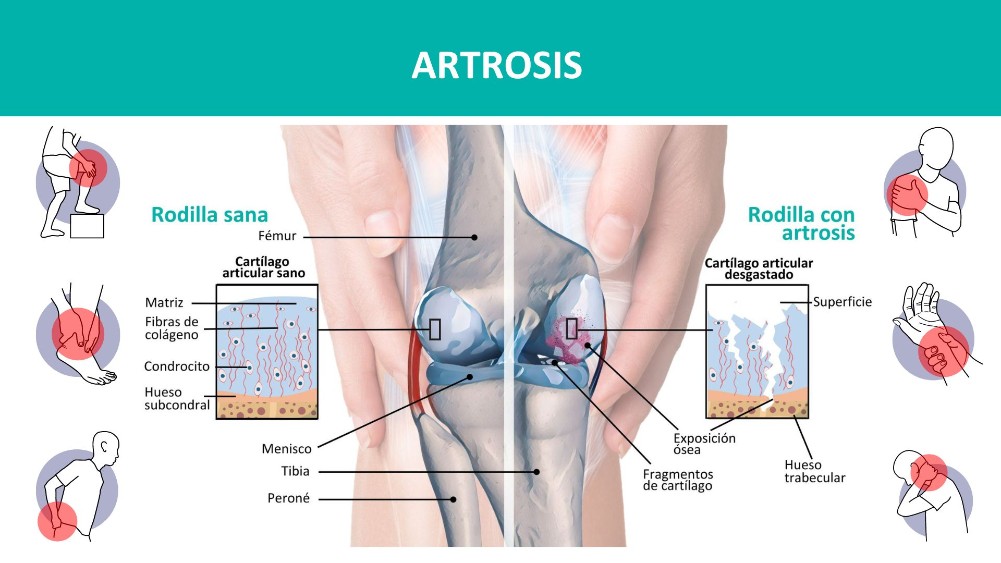
When osteoarthritis develops, cartilage loses its properties and may even disappear. In advanced stages, and in an attempt by the body to repair the damaged joint, chemical substances accumulate in the joint, increasing the production of cartilage and bone components. This leads to new bone and tissue growth. Bone grows excessively at the edges of the joint, producing bony outgrowths (osteophytes) that can be seen and felt. The smooth, regular surface of the cartilage becomes rough and porous, causing friction within the joint and preventing smooth movement.
Pain is usually the initial symptom of osteoarthritis. It has an insidious onset and is perceived as deep and poorly localized. Its intensity increases over the years, although in many patients—especially in the early stages—it may follow an intermittent course, with symptom-free periods lasting years.
In spinal osteoarthritis, pain occurs in the neck or lower back region, limiting movement and often causing muscle spasms in the affected area.
Pain is generally triggered by exercise and improves or disappears with rest. As the disease progresses, the pain becomes more continuous, lasts longer, and may occur with any movement of the affected joint. In the most severe cases, pain may be almost constant, even at rest.