





Astigmatism
Astigmatism is a type of vision problem that prevents clear vision of objects both at a distance and up close.
Astigmatism is a refractive error in which objects may appear distorted, elongated, or wider than they actually are; sometimes shadows may also appear.
In most cases, astigmatism is due to a lack of symmetry (toricity) of the cornea.
Astigmatism is one of the so-called refractive errors, a group of eye conditions in which the image does not focus precisely on the retina, resulting in blurred vision. Normally, the cornea and the crystalline lens bend (refract) the light rays entering the eye to focus them on the retina, the light-sensitive layer of tissue located at the back of the eye.
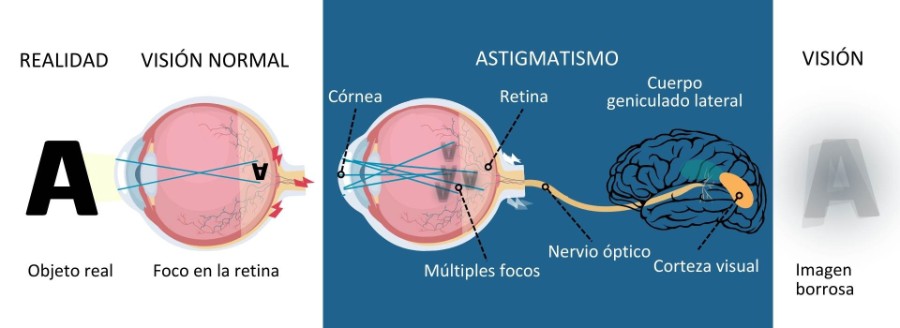
The retina converts the received light into electrical signals that are sent through the optic nerve to the brain. If the light is not properly focused on the retina, the information sent from the eye to the brain is defective. In astigmatism, light rays focus on different points on the retina. This causes blurred vision at all distances. Astigmatism may be associated with both myopia (nearsightedness) and hyperopia (farsightedness).
Astigmatism can be corrected with glasses or contact lenses, through laser refractive surgery, or by the implantation of intraocular lenses.
Our Ophthalmology Unit, led by Dr. Isabel Garabito, has a large team of professionals specialized in the different medical and surgical areas of ophthalmology, allowing us to provide comprehensive and specialized care for all vision disorders.
Equipped with the latest technology, the Ophthalmology Unit has recently incorporated 100% laser, no-contact surgery equipment (TECHNOLAS® TENEO™ 317 Model 2), as well as the Cirrus 6000 by Zeiss for performing OCT (optical coherence tomography), a diagnostic, monitoring, and follow-up technique for conditions affecting the macula and other areas of the retina.