





Cerebral Aneurysm
A dilation in the wall of a cerebral artery that can rupture and cause intracranial bleeding, requiring immediate medical treatment.
A cerebral aneurysm is an abnormal widening or dilation of an artery in the brain, caused by a weakened area in the artery wall that bulges due to the pressure of blood flow.
The wall of the aneurysm is thin and weak, which means it can leak or rupture and cause bleeding in the brain (hemorrhagic stroke), a medical emergency that requires immediate treatment to stop the bleeding and prevent brain damage.
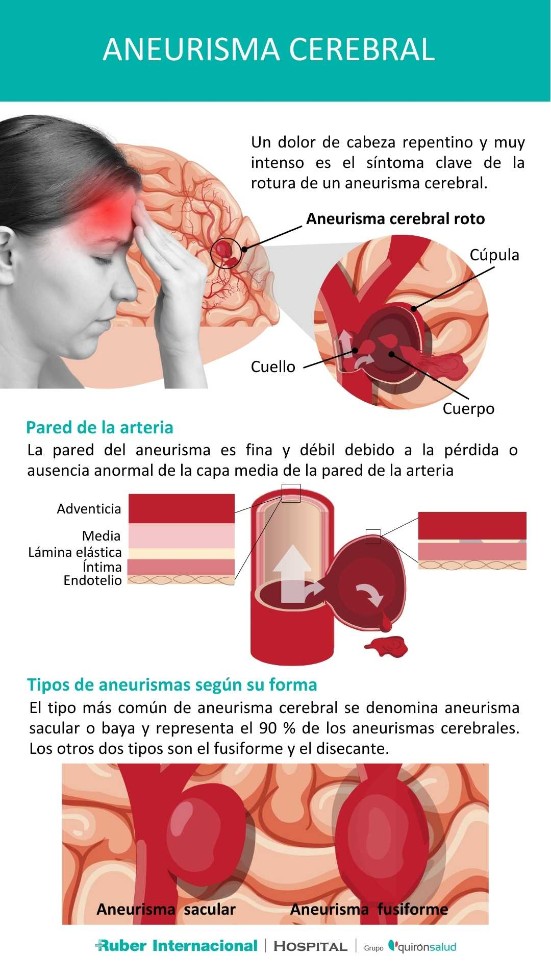
The rupture of a cerebral aneurysm causes a sudden and extremely severe headache, which some people describe as the "worst headache" they have ever experienced.
Most unruptured cerebral aneurysms do not produce symptoms and are small in size (less than 10 millimeters). However, larger aneurysms can press on brain tissue and nerves, causing headaches that may throb in rhythm with the pulse.
The diagnosis of a cerebral aneurysm requires imaging studies such as computed tomography angiography (CTA) or magnetic resonance angiography (MRA).
Treatment of cerebral aneurysms can be divided into two main groups: traditional open surgery, in which the skull is opened (craniotomy) and a metal clip is placed to close the aneurysm; and endovascular embolization, a minimally invasive procedure that uses the network of arteries to reach the aneurysm and close it without the need to open the skull.
Our hospital has distinguished and experienced Interventional Neuroradiologists and the most advanced technology available worldwide to perform these treatments.
Recently, we have acquired the Philips Azurion 7 B20/15 biplane angiography system, which allows us to perform endovascular embolization more effectively and safely, enabling real-time monitoring of cerebral anatomy in two spatial planes simultaneously, as well as in three-dimensional (3D) and four-dimensional (4D) imaging.