




Hyperopia (Farsightedness)
Hyperopia is a type of vision problem that makes it difficult to see nearby objects clearly.
Hyperopia is a type of vision problem that makes it difficult to see nearby objects clearly. It occurs when there is a shortening of the anteroposterior axis of the eye or when the curvature of the cornea, the lens, or both is flatter than normal. In some cases, hyperopia is caused by a combination of these two factors.
Hyperopia is one of the so-called refractive errors, a group of eye conditions that prevent images from focusing precisely on the retina, resulting in blurred vision. Normally, the cornea and the lens bend (refract) the light rays entering the eye to focus them on the retina, the light-sensitive layer of tissue located at the back of the eye. The retina converts the received light into electrical signals that are sent through the optic nerve to the brain. If light does not focus on the retina, the information sent from the eye to the brain is defective. In the case of hyperopia, light focuses behind the retina, causing nearby objects to appear blurry.
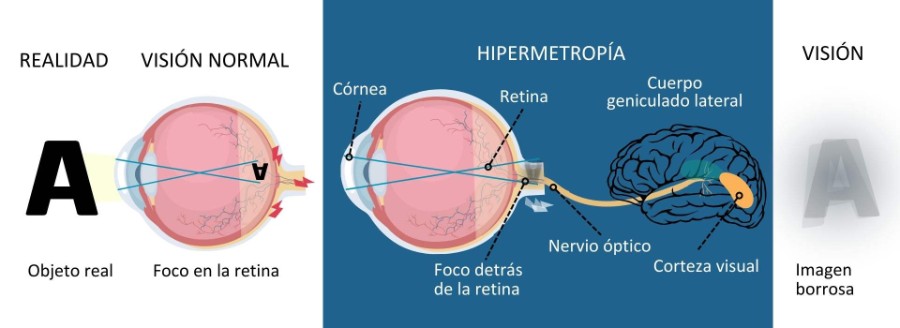
Hyperopia can be corrected with glasses or contact lenses, and through laser refractive surgery.
Our Ophthalmology Unit, led by Dr. Isabel Garabito, has a large team of professionals specialized in the different medical and surgical areas of Ophthalmology, enabling us to provide comprehensive and specialized care for all vision disorders.
Equipped with the latest technology, the Ophthalmology Unit has recently incorporated equipment for 100% laser, contact-free surgery, the TECHNOLAS® TENEO™ 317 Model 2, as well as the Zeiss Cirrus 6000 system for performing OCT (optical coherence tomography), a diagnostic technique used for the evaluation, monitoring, and follow-up of macular conditions and other areas of the retina.