





Macular Degeneration (AMD)
Discover everything about macular degeneration, its symptoms, causes, types, diagnosis, and available treatments at Hospital Ruber Internacional.
What Is Macular Degeneration?
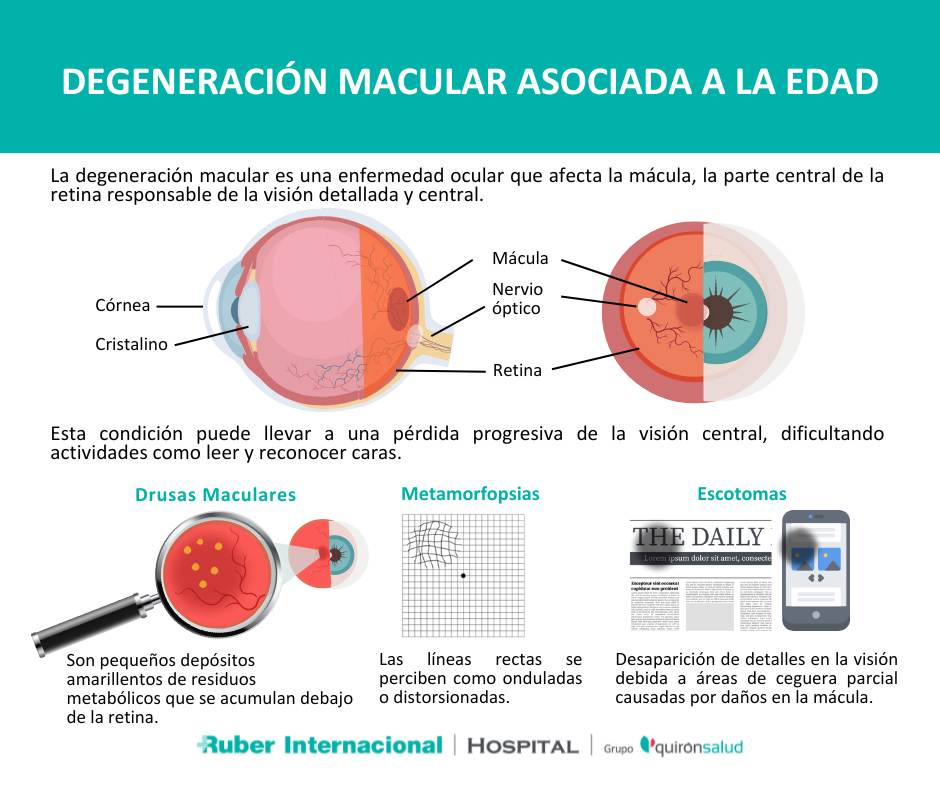
Macular degeneration is an eye disease that affects the macula, a small area in the center of the retina responsible for sharp central vision needed for activities such as reading and recognizing faces. It is one of the leading causes of vision loss in people over 50 years of age.
Types of Macular Degeneration
Dry (Atrophic) Macular Degeneration
Description: This is the most common form, accounting for approximately 85–90% of cases. It is characterized by thinning and aging of the macula.
Symptoms: Gradual loss of central vision, dark spots in the central visual field, difficulty reading and recognizing faces.
Progression: Generally progresses slowly.
Wet (Neovascular) Macular Degeneration
Description: Less common but more severe, representing about 10–15% of cases. It occurs when abnormal new blood vessels grow beneath the retina and macula.
Symptoms: Rapid loss of central vision, distortion of straight lines (they appear wavy), dark spots in the center of vision.
Progression: Can progress quickly and cause severe central vision loss.
 This link opens in a popup window
Symptoms of Macular Degeneration
- Blurred or distorted vision in the center of the visual field.
- Difficulty seeing fine details.
- Appearance of dark or empty spots in the center of vision.
- Trouble recognizing faces.
- Need for more light to perform daily activities.
- Difficulty adapting to low light.
Causes of Macular Degeneration
The exact causes of macular degeneration are not fully understood, but several risk factors have been identified:
- Advanced age: Higher risk in people over 50 years old.
- Genetics: Family history of the disease.
- Smoking: Significantly increases the risk.
- Obesity: Associated with a higher risk of progression.
- Poor diet: Lacking essential nutrients for eye health.
- Sun exposure: Prolonged exposure without adequate protection.
Diagnosis of Macular Degeneration
Macular degeneration is diagnosed through several methods:
- Comprehensive eye examination: Includes medical history review and evaluation of central vision.
- Amsler grid test: To detect distortions in the visual field.
- Optical coherence tomography (OCT): Provides detailed images of the retina.
- Fluorescein angiography: Used to visualize retinal blood vessels and detect abnormalities.
Treatment of Macular Degeneration
There is no cure for macular degeneration, but treatment options can help slow progression and manage symptoms.
Treatment for Dry Macular Degeneration
- Vitamin supplements: Specifically formulated for eye health (containing antioxidants and zinc).
- Dietary changes: Increased intake of foods rich in vitamins C and E, lutein, zeaxanthin, zinc, and omega-3 fatty acids.
- Regular monitoring: To detect changes in vision.
- Intravitreal injections: Anti-VEGF medications to reduce abnormal blood vessel growth.
- Photodynamic therapy: Use of laser and photosensitizing medications to treat abnormal blood vessels.
- Thermal laser therapy: To seal abnormal blood vessels, although it is less commonly used today.
Treatment for Wet Macular Degeneration
- Quit smoking and avoid secondhand smoke.
- Maintain a healthy, balanced diet rich in fruits, vegetables, and fish.
- Protect eyes from excessive sunlight with UV-protective sunglasses.
- Undergo regular eye examinations, especially after age 50.
Prevention of Macular Degeneration
Ophthalmology Service at Hospital Ruber Internacional
The Ophthalmology Service at Hospital Ruber Internacional, led by Dr. Isabel Garabito, has extensive experience in the management of macular degeneration. The service features a multidisciplinary team and state-of-the-art technology and resources for the diagnosis, treatment, and follow-up of this condition.