





Parkinson’s Disease: Definition, Symptoms, Diagnosis, and Treatment
Dr. Mónica Kurtis, Neurologist and specialist in Movement Disorders at the Neurology Unit of Hospital Ruber Internacional, explains this neurodegenerative disease that affects millions of people worldwide.
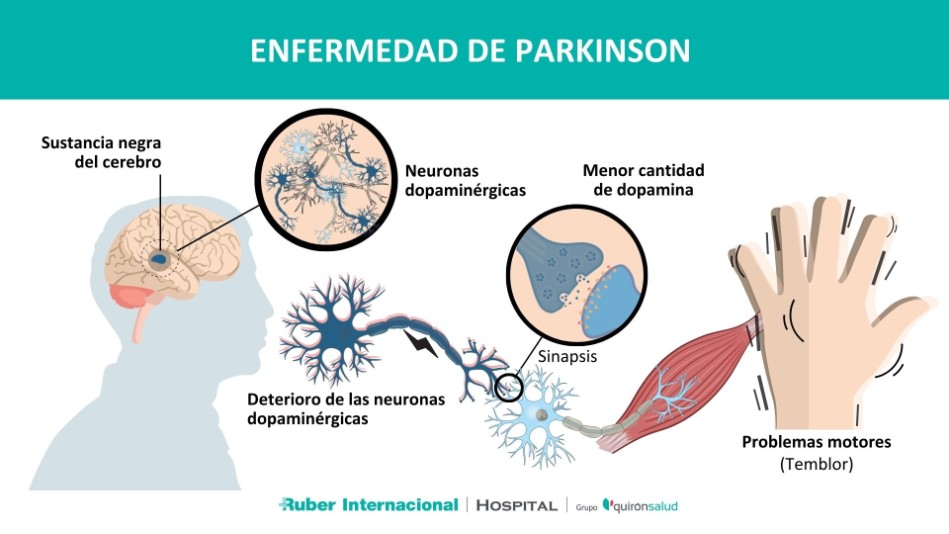
What Is Parkinson’s Disease?
Parkinson’s disease is the second most common neurodegenerative disorder (surpassed only by Alzheimer’s disease) and affects more than 10 million people worldwide. In recent decades, its prevalence has increased exponentially for reasons that are not yet fully understood.
The disease usually begins between the ages of 60 and 70, but it is important to note that it is not exclusive to older individuals, as 15% of cases begin in people under the age of 45. In most patients, no specific cause is identified, although in a small percentage (3–5%) a genetic mutation responsible for the disease is detected.
At the brain level, patients lose nerve cells (neurons) that produce dopamine. Dopamine is the brain’s chemical messenger responsible for coordinating movement. Its deficiency results in both motor and non-motor symptoms.
What Are the Most Common Symptoms?
Dopamine deficiency leads to the symptoms that characterize the disease. All patients typically experience slowness of movement and stiffness or tension in certain muscles. They may seek medical attention due to persistent shoulder pain, difficulty writing, dragging one leg, or a generalized slowness that makes daily tasks—such as dressing or personal hygiene—take longer.
Approximately 66% of patients also develop tremor in one hand or leg that appears at rest, for example while sitting and watching television or conversing. Some patients may also experience walking difficulties, imbalance, and instability.
Parkinson’s is not only a movement disorder, as it can also present with non-motor symptoms that significantly impact quality of life. Patients frequently experience insomnia, very vivid dreams, mood changes, memory or concentration problems, and autonomic nervous system disturbances that cause constipation, excessive sweating, urinary urgency, and dizziness upon standing.
How Is It Diagnosed?
The diagnosis of Parkinson’s disease is clinical. Currently, there is no imaging or blood test that can definitively confirm or rule out the disease. Diagnosis is based on the patient’s medical history and neurological examination.
It is important to perform a differential diagnosis to rule out other conditions that may "mimic" Parkinson’s disease. Therefore, general blood tests are recommended to exclude metabolic disorders, and brain imaging studies are performed to ensure there are no structural lesions causing parkinsonian symptoms.
At our hospital, we are pioneers in detecting degenerative parkinsonism using specific magnetic resonance imaging (MRI) techniques targeting a particular area of the brainstem known as the nigrosome.
In some patients, a nuclear medicine test called SPECT with radiolabeled tracer (DAT Scan®) may also be helpful in confirming dopamine circuit dysfunction. However, this test does not distinguish Parkinson’s disease from other degenerative parkinsonian syndromes such as multiple system atrophy or progressive supranuclear palsy.

Currently, there is no cure for Parkinson’s disease, but multiple treatments are highly effective in alleviating symptoms.
Pharmacological treatments include:
- MAO-B inhibitors such as rasagiline or safinamide
- Dopamine agonists in tablet form (pramipexole, ropinirole) or patch form (rotigotine)
- Levodopa (dopamine replacement), the most effective treatment
- COMT inhibitors (opicapone and entacapone), which may be combined with levodopa in some patients
In patients with advanced Parkinson’s disease, second-line therapies may be considered, including continuous infusion pump therapies and functional neurosurgery.
An essential part of treatment goes beyond medication. Physical activity—especially aerobic exercise and stretching—along with a healthy diet and active social and intellectual engagement, plays a crucial role in patient well-being.