




Presbyopia
It can be corrected with glasses or contact lenses. Refractive surgery can reduce dependence on glasses or contact lenses in many cases.
Presbyopia is the gradual loss of the eyes’ ability to focus on nearby objects. It is a natural part of the aging process of the eye and usually becomes noticeable around the age of 45, when we find that we need to hold reading materials farther away to focus, experience eye strain and fatigue (when the eyes feel irritated), or develop headaches after performing detailed tasks.
Causes
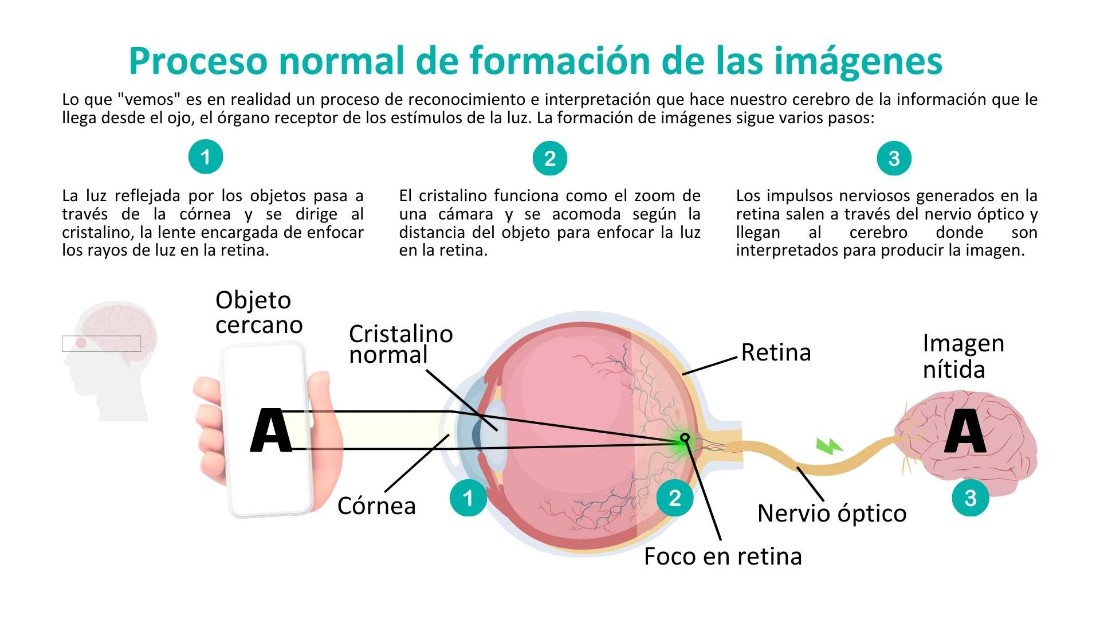
Presbyopia results from the loss of flexibility of the crystalline lens, the eye’s natural lens, which functions like the zoom of a camera by adjusting to focus clearly on objects at different distances.
The lens is slightly flexible and can change shape with the help of a circular muscle that surrounds it (the ciliary muscle). When you look at something far away, the ciliary muscle relaxes. When focusing on a nearby object, the ciliary muscle contracts, allowing the lens to curve and focus light sharply onto the retina.
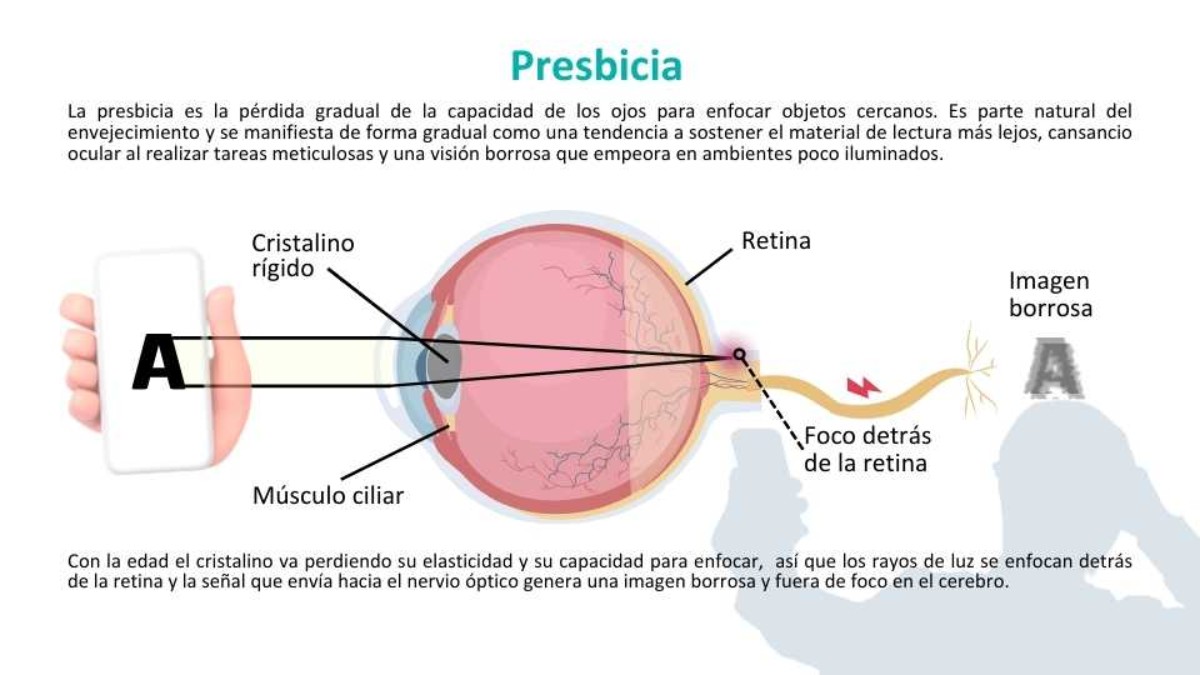
The progressive hardening or loss of elasticity of the lens caused by aging leads to the reduced ability of the eye to focus on close objects.
Diagnosis.
A basic eye exam, including a refraction assessment and a general eye health evaluation, is sufficient to diagnose presbyopia.
To evaluate both near and distance vision, the ophthalmologist will ask you to look at objects placed at different distances while viewing through various lenses. The doctor will likely use eye drops to dilate your pupils in order to examine the inside of your eyes more thoroughly. These drops may cause increased sensitivity to light for a few hours after the exam.
Regular eye health evaluations are an essential part of preventive medical check-ups. As a general rule, it is recommended to have an eye exam once a year if there are no warning symptoms. If any condition is present, it is ideal to have your vision checked every six months.
Treatment
Presbyopia cannot be cured, but several methods can help compensate for focusing difficulties. The main goal of treatment is to alleviate the eyes’ inability to focus on nearby objects. The primary treatment options include optical correction with glasses, the use of contact lenses, or refractive surgery.
Thanks to advances in refractive surgery, it is now possible to reduce dependence on glasses or contact lenses for many patients. Before undergoing refractive surgery, a personalized assessment is required to evaluate factors such as age, visual needs, profession, and personal preferences in order to determine the most appropriate procedure or treatment in each case.
Our Ophthalmology Unit, led by Dr. Isabel Garabito, has highly trained specialists in the various medical and surgical areas of ophthalmology, as well as the most modern and advanced technology for the diagnosis and treatment of presbyopia.