





Strabismus
Strabismus is the loss of proper eye alignment, in which one eye becomes dominant (the fixing eye) and remains straight while the other eye deviates in any direction—vertical, horizontal, or oblique.

Causes
Strabismus can appear at any age and may be caused by various factors, including poor vision in one eye, cataracts, trauma, paralysis, infections, tumors, etc.

Symptoms
It is normal for newborns not to fix their gaze steadily; however, if the deviation persists beyond 3–6 months of age, the child should be evaluated by an ophthalmologist to establish an early diagnosis and treatment.
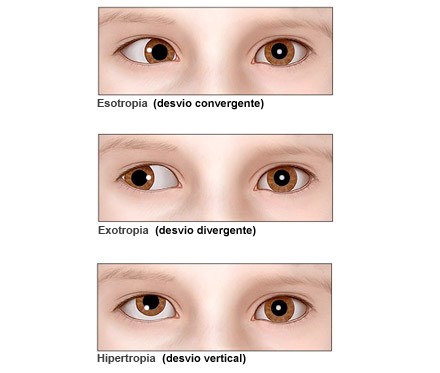
Depending on the direction of the eye deviation, strabismus may be classified as:
- Esotropia (endotropia): eyes deviated inward
- Exotropia: eyes deviated outward
- Hypertropia: eye deviated upward
- Hypotropia: eye deviated downward
If the degree of strabismus is small, it may not be cosmetically noticeable, but it can still cause symptoms such as torticollis (tilting or turning the head to one side or toward the shoulder), headaches, discomfort while reading, eye strain, and shaky vision. It may also contribute to the development of amblyopia (lazy eye).
Other possible symptoms include difficulty judging distances or depth perception, "shadowed" vision, or double vision (diplopia).

Treatment
Treatment may include:
- Medical treatment: glasses, prisms, patching (occlusion therapy), optical or pharmacological penalization, and orthoptic exercises.
- Surgical treatment: botulinum toxin injections or surgery.