




Dentistry
Your smile is our priority
Welcome to the Dentistry Department at Hospital Ruber Internacional!
At our hospital, we are committed to providing you with the highest standard of care to keep your smile healthy and radiant at all times. From our youngest patients to older adults, we are here to offer comprehensive, personalised dental care.
From Cosmetic Dentistry to Orthodontics, you will find a wide range of treatments designed to help you achieve the smile you have always wanted. Our highly qualified team will be by your side throughout the entire process, guiding you every step of the way and working to achieve excellent, long-lasting results.
We are here to take care of your oral health and ensure that your smile looks its best at all times.
Committed to Your Oral Health

Oral health has a significant impact on overall health and on our patients’ quality of life. For this reason, at Ruber Internacional, our goal is to approach oral healthcare comprehensively, taking into account both the individual characteristics and needs of each patient and their overall health.
We use the most advanced technologies to develop personalised treatment plans aimed not only at treating oral diseases, but also at improving our patients’ overall health.
Our team includes professionals specialising in the following areas:
- Dental Implantology
- Cosmetic Dentistry and Oral Rehabilitation
- Orthodontics and Dentofacial Orthopaedics
- Restorative Dentistry and Endodontics
- Periodontics and Periodontal Plastic Surgery
- Paediatric Dentistry
- Oral Medicine
- Dentistry Unit for High-Risk Patients
- Oral Surgery
- Orthognathic Surgery
- Sleep Apnoea
Our Passion, Your Perfect Smile
What is it?
Dental implants are used to replace missing teeth. They consist of three components:
- Dental implant: an artificial titanium root made from a biocompatible material that is surgically anchored into the bone.
- Prosthetic abutment: attached to the implant and used to support the crown.
- Ceramic crown: provides the appearance of a natural tooth and restores both aesthetics and function.
Implant dentistry can be used to replace one, several or all missing teeth. One of its main advantages over conventional prosthetic solutions is that neighbouring teeth do not need to be treated. In addition, implants help prevent the bone resorption that naturally occurs in areas of the jaw where teeth are missing.
At the Oral and Maxillofacial Surgery and Dentistry Department at Ruber Internacional, diagnosis and treatment planning are carried out using digital technologies that enable precise, personalised treatment for each patient. Patients are also enrolled in a maintenance programme designed to preserve the health and function of their implants over the long term.

Cosmetic dentistry is the branch of dentistry focused on restoring or improving the harmony and appearance of the smile. At our centre, we use digital smile design, allowing patients to preview the potential results before undergoing treatment.
Teeth whitening
Teeth whitening is a treatment that combines in-clinic and at-home procedures with the aim of lightening the shade of the teeth. At our unit, we carry out an assessment to determine which patients may benefit from whitening and provide recommendations, such as avoiding tobacco and certain foods, to help achieve more stable, long-lasting results.
Ceramic veneers
This minimally invasive treatment can improve the colour and shape of the teeth, enhancing both the smile and chewing function.
Porcelain veneers are thin, individually manufactured shells produced in a dental laboratory and bonded to the tooth enamel to improve the shape, colour and/or brightness of the teeth. They provide a highly natural appearance and excellent durability.
Veneers can also be placed directly in the clinic using composite resins applied in layers to reproduce the natural colour and translucency of the tooth.
Depending on the individual needs of each patient, we recommend the most appropriate option.
Dental prostheses
Dental prosthetic treatment involves replacing missing teeth using prostheses that may be supported by neighbouring teeth, dental implants and/or the oral mucosa, depending on the patient's needs and clinical situation. The aim is to restore lost chewing function and aesthetics.
Periodontal plastic surgery
Achieving a harmonious smile is not only about having attractive teeth. Healthy gums with the correct shape and position are also essential.
What treatments does it include?
- Gum grafting. Used in cases of gingival recession to cover exposed tooth roots.
- Gummy smile treatment. We carry out a multidisciplinary assessment and treatment to aesthetically correct cases where excessive gum tissue is visible when smiling and/or the teeth appear too short.
- Treatment of pigmented gums.

Restorative dentistry combines different dental specialties to repair teeth damaged by decay, trauma and/or dental wear, with the aim of preserving them for as long as possible.
What treatments does it include?
- Restorations. Modern techniques allow us to restore lost tooth structure using a highly conservative approach, restoring dental health and function while promoting long-term tooth preservation.
- Composite resin restorations.
- Ceramic inlays and onlays: in cases of extensive tooth damage, ceramic restorations can restore lost function and anatomy while improving the strength of the tooth.
- Endodontics. Root canal treatments involve removing the affected dental pulp when it has been damaged by the progression of tooth decay or dental trauma, allowing the tooth to remain functional.

Orthodontics is the branch of dentistry concerned with correcting the position of the teeth to improve both aesthetics and chewing function. It is increasingly common among adults, not only children and adolescents. At the Dentistry Unit at Ruber Internacional, we offer treatments adapted to the individual needs of each patient.
What treatments does it include?
- Interceptive orthodontics and dentofacial orthopaedics. These treatments correct skeletal problems during a child's facial development. An assessment at around the age of six is essential to determine whether treatment is needed and to correct bite problems as simply and effectively as possible. Treatment may involve functional appliances, fixed multibracket braces and/or clear aligners.
- Corrective orthodontics. This aims to correct dental and skeletal malpositions once growth has been completed, in both young people and adults. We use digital tools to plan and carry out treatment with clear aligners, gradually moving the teeth using transparent trays.
- Management of mouth breathing and multidisciplinary treatment of sleep apnoea in children and adults. Mouth breathing and paediatric sleep apnoea are often associated with a narrow palate. We work closely with the Sleep Unit at Hospital Ruber Internacional to identify and correct these problems at an early stage.
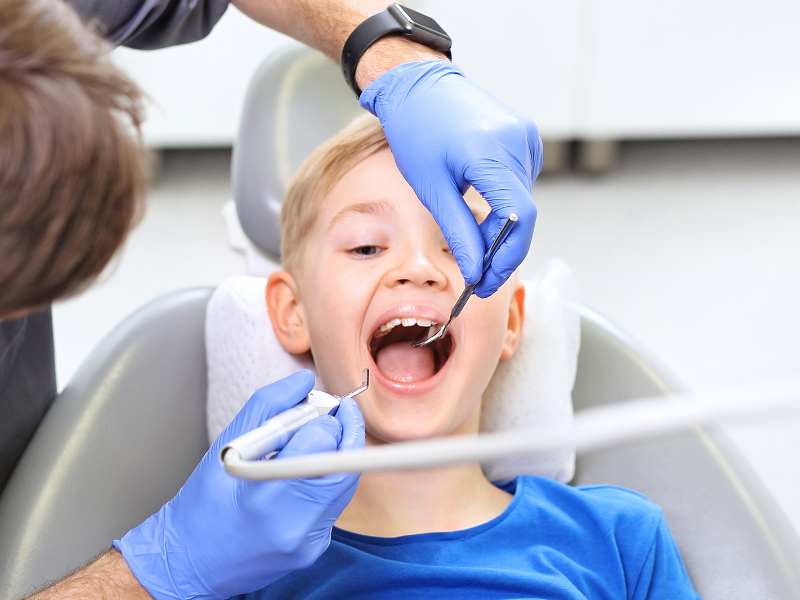
The Paediatric Dentistry Unit at Hospital Ruber Internacional focuses on the diagnosis and treatment of oral conditions affecting children and adolescents.
Our philosophy is to make children feel comfortable during their visit by creating a welcoming, positive and reassuring environment. We recommend that a child's first visit to a paediatric dentist take place between the ages of two and three. This allows us to monitor their primary teeth appropriately and explain to both parents and children the measures they can take to help prevent tooth decay.
Objectives
- Prevention and oral hygiene education.
- Treatment of tooth decay in primary and permanent teeth.
- Monitoring of dental growth and development.
- Early management of dental trauma.
- Care for patients with special needs.
- Coordination with Paediatrics and other hospital specialties.
Hospital setting
The Paediatric Dentistry Unit works closely with the Paediatrics Department at Ruber Internacional to ensure that our patients follow appropriate measures to maintain good oral health and to facilitate the early diagnosis of abnormalities affecting jaw development, mouth breathing, dental development and/or tooth eruption.
In paediatric patients with extensive dental disease or those who require it for other reasons, treatment can be carried out safely in the operating theatre under general anaesthesia.

Gingivitis and periodontitis
Periodontal diseases are infectious conditions caused by bacteria that affect the gums and the bone supporting the teeth. There are two main types of periodontal disease: gingivitis and periodontitis.
Initially, bacteria accumulate around the gums, causing gingivitis, which is characterised by bleeding and inflammation but is reversible. However, if left untreated, it may progress to periodontitis, leading to bone loss around the teeth and potentially resulting in tooth loss over time.
The most common symptom is spontaneous bleeding or bleeding during tooth brushing. Other symptoms may include pus around the gums, an unpleasant taste in the mouth, gum redness, gum recession, gaps developing between teeth and tooth mobility.
Furthermore, because periodontitis is a bacterial infection, it can have systemic effects, and scientific evidence has identified associations between periodontitis and other conditions such as diabetes, cardiovascular disease and Alzheimer's disease.
Because periodontal diseases often go unnoticed as they may not cause pain, early diagnosis and treatment of periodontitis are essential to preserve the teeth for as long as possible and reduce the potential systemic effects associated with the condition.
Peri-implant diseases
Peri-implantitis is a bacterial infection that causes bone loss around dental implants and may ultimately lead to implant loss. The aim of treatment is to stop the progression of the disease and, where possible, regenerate some of the lost bone in order to maintain the implant's function for as long as possible.
At the Oral and Maxillofacial Surgery and Dentistry Unit at Ruber Internacional, we place particular emphasis on prevention. We teach patients how to maintain healthy teeth and implants and enrol them in a maintenance programme designed to support the long-term success of their treatment.
Oral and maxillofacial surgery is the medical specialty responsible for the diagnosis and treatment of congenital or acquired conditions and trauma affecting the oral cavity, face and neck.
This includes:
- Temporomandibular joint disorders.
- Removal of maxillary and mandibular cysts.
- Extraction of wisdom teeth.
- Bone regeneration for subsequent implant-supported rehabilitation.
Orthognathic surgery is a procedure designed to correct malposition of the upper and lower jaws in order to improve chewing function, the airway and facial harmony.
It is particularly indicated in cases where abnormalities in jaw development have resulted in bite or occlusion problems; periodontal problems involving the relationship between the teeth, gums and supporting bone; temporomandibular joint disorders; altered facial proportions affecting facial aesthetics; and/or sleep apnoea.